START HERE
The essential idea
Build and interpret a focused fictional family map without converting patterns into untested diagnoses or causes.
BUILD THE REASONING · 01
Decide what the map is supposed to help you understand
A genogram is a structured representation of family membership, relationships, and relevant events across generations. Its clinical value comes from the questions it helps people ask. A densely labeled chart is not automatically a better assessment. Before drawing, identify a purpose with the client: understanding a recent caregiving transition, locating support, exploring changes around a separation, or clarifying who is affected by a decision. A broad family history can be useful, but the counselor should be able to explain why the information being requested is relevant.
A Bowen family diagram has a particular theoretical history; the many tools now called genograms are not interchangeable applications of that theory. The Bowen Center explicitly distinguishes its family-diagram tradition from later adaptations. Learn the model being used rather than assuming every relationship line demonstrates a Bowen concept. In this introductory exercise, the map organizes information and hypotheses. It does not establish a diagnosis, inherited emotional trait, or causal mechanism.
Invite the client to define important family and support relationships. Biological kinship, adoption, step relationships, chosen family, close friends, and cultural or community connections can have different meanings. A conventional symbol set may be useful for communicating with other clinicians, but it must have a clear legend. Ask about identities and preferred descriptions; do not infer them from a role such as parent, partner, or caregiver. If a symbol is unfamiliar or unsuitable, explain the alternative being used so that future readers do not mistake an adaptation for a standard meaning.
BUILD THE REASONING · 02
Build structure, then events, then attributed relationship information
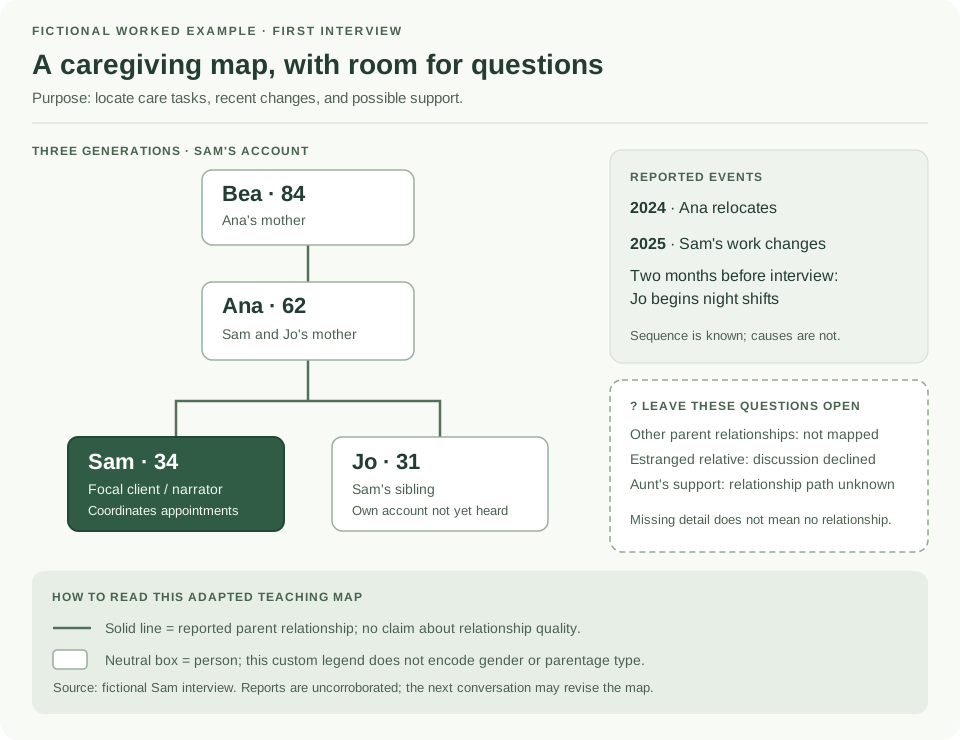
Construct the example below from Sam’s account. Put Sam, 34, in the focal box and sibling Jo, 31, beside Sam. Place their mother Ana, 62, one generation above, then Ana’s mother Bea, 84, above Ana. Connect only those reported parent relationships. The custom legend uses neutral boxes and solid parent lines; it does not encode gender, biological or adoptive status, or emotional closeness. Leave other parents and the declined branch unmapped rather than inventing a relationship, death, or absence.
Next add the separate event panel: Ana’s relocation in 2024, Sam’s work change in 2025, and Jo’s night shift two months before the interview. These dates do not belong on a line as proof of emotional distance. A relationship described as distant may have changed after migration, a death, a new job, illness, or a housing disruption. Note when a report applies. “Little contact since the move in 2024” is more useful than a permanent label of emotional cutoff when the counselor has not examined the meaning of the change. The time sequence helps compare explanations and prevents the map from compressing several different periods into one fixed family portrait.
Add relationship descriptions with a source. “Sam reports tension with Jo since the care schedule changed” is different from “Sam and Jo have a conflictual relationship.” The first identifies who supplied the information, the period involved, and the event to investigate. If Jo is not present, the map is not Jo’s account. Mark observed session behavior separately from client reports and tentative clinical interpretations. Store the map as confidential clinical information under the setting’s applicable record rules, with no assumption that every family member may receive an identical copy.
Swipe or scroll horizontally to compare all columns. With a keyboard, focus this table and use the arrow keys.
| Layer | Fictional entry | What it does not establish |
|---|---|---|
| Structure | Sam, 34; sibling Jo, 31; mother Ana, 62; grandmother Bea, 84 | Who should be responsible for care |
| Event | Ana moved closer to Bea in 2024; Sam changed work hours in 2025 | Why either person made the decision |
| Attributed report | Sam says Jo is less available since a new shift pattern | Jo’s intention or willingness to help |
| Open question | Who provides practical and emotional support outside this four-person map? | That family members are the only useful supports |
BUILD THE REASONING · 03
Treat a repeating pattern as a question, not a verdict
Suppose Sam notices that Ana cared for Bea, and Sam now coordinates Ana’s medical appointments. “The oldest child always becomes the caregiver” is one possible interpretation, but the map alone cannot establish it. Availability, income, geography, language, disability, preferences, and family expectations may all contribute. Ask who actually did which tasks at each period, who was asked, and what alternatives were available. Repeated caregiving may carry pride and connection, resentment and exhaustion, or several meanings at once.
A useful hypothesis includes a way to discover that it is incomplete. One hypothesis is that Sam feels unable to refuse requests because refusal is understood as disloyalty. Another is that Sam is the only person with a flexible work schedule. A third is that the available transport service has not been explained to the family. These explanations suggest different questions and actions. Ask what happened the last time someone said no, compare work schedules, and identify services the family has already tried. Do not resolve the uncertainty by choosing the explanation that best matches a favorite theory.
Look for strengths and exceptions with the same specificity used for difficulties. Who helped during an earlier transition? What agreement reduced conflict? Which relationships feel dependable, and in what situations? A supportive aunt who lives elsewhere may provide planning help even when she cannot provide transport. A neighbor may be part of the practical support network without being a relative. The purpose is not to force a positive interpretation; it is to avoid designing a plan from an incomplete inventory of burdens alone.
BUILD THE REASONING · 04
Translate the map into a focused next step
At the end of an initial mapping conversation, summarize what is established, what remains a hypothesis, and what the client wants to do with it. The next step may be a more detailed interview, a discussion with a consenting participant, a resource inquiry, or a small change in the care plan. The map does not select the intervention automatically. If the presenting issue is transport access, a broad interpretation about intergenerational anxiety may be less immediately useful than identifying who can book a ride and how the arrangement will be confirmed.
Protect the client’s choice about disclosure. A genogram can bring up adoption, reproductive history, estrangement, trauma, legal disputes, and information about people who are not clients. Explain the purpose and let the client decide whether to discuss a topic, within the legal and clinical duties of the setting. Obtain appropriate permission before contacting others. Sensitive information shared individually can affect later conjoint work, so the information policy needs to be clear before collecting it. A training map should use fictional people rather than identifiable client histories.
Revise the map as new information arrives. If Jo later explains that a night shift rather than relationship withdrawal limited availability, correct the earlier interpretation and retain clear attribution. If Sam learns that Bea prefers a different arrangement, that preference belongs in the decision. If information suggests coercion or unsafe participation, reassess safety and the suitability of joint work instead of using a family-pattern explanation to distribute blame. A good first map remains readable, provisional, and connected to the client’s actual concern.
FROM CONCEPT TO DECISION
A caregiving map that changes the question
Fictional client Sam, 34, feels solely responsible for helping mother Ana, 62, support Ana’s mother Bea, 84, who is Sam and Jo’s maternal grandmother. Sam’s sibling Jo, 31, appears less involved. Sam initially describes this as an inherited pattern: “The oldest child does everything.”
Agree the purpose and boundaries
The counselor asks whether mapping caregiving and available support would help Sam decide what to request. Sam agrees but does not want to discuss an estranged relative today. That branch remains open instead of being filled through guesswork.
Place tasks and transitions in time
Ana moved in 2024. Sam’s flexible work arrangement began in 2025. Jo’s new night shift began two months ago. The chart records actual tasks and these changes, which permits a practical explanation alongside a family-expectation explanation.
“Before Jo’s shift changed, who handled the appointments? What changed first: availability, the requests, or how people understood one another?”
Compare hypotheses and include resources
Sam reports no recent attempt to ask Jo for a weekend task, and describes an aunt who helped coordinate care during an earlier illness. Those details do not prove that a request will be accepted. They identify two options that the initial story left out.
Choose a bounded next action
Sam plans a specific weekend request and an inquiry about transport support, rather than confronting the family with the claim that they always exploit the oldest child. The next appointment will review the responses, Sam’s feelings, and any information requiring a different plan.
The map makes a practical decision better informed. The repeated caregiving pattern remains a hypothesis to explore, not proof of destiny, diagnosis, or equal responsibility.
MAKE THE REASONING YOURS
Work through a new situation
Put the lesson to work.
4 case-based questions. Plausible choices. Feedback that explains the distinction.
READ WITH A PURPOSE
Best references
These readings deepen the specific models, evidence, and decisions in this lesson.
- The Bowen Center: Family Diagram
Explains the family-diagram tradition and its differences from later genogram adaptations. Use it to keep a tool’s theoretical assumptions visible.
- SAMHSA TIP 39: Family counseling approaches
Places family assessment and interventions within distinct therapeutic approaches and substance-use treatment. Useful for connecting a map with a reasoned clinical question.
- AAMFT Code of Ethics, effective January 2026
Provides standards relevant to consent, confidentiality, and multiple participants. Read alongside the laws and professional code applicable to your counseling role.
KEEP THE TAKEAWAY
The map makes a practical decision better informed. The repeated caregiving pattern remains a hypothesis to explore, not proof of destiny, diagnosis, or equal responsibility.
Save this lesson to your study log. Your case-practice result is shown separately in the quiz.
Sign in to save progressIndependent educational material for study alongside course readings and supervision. Examples are fictional. Completion and quiz scores do not establish clinical competence, university credit, or exam readiness. AI-assisted content review is separate from qualified human educational approval.